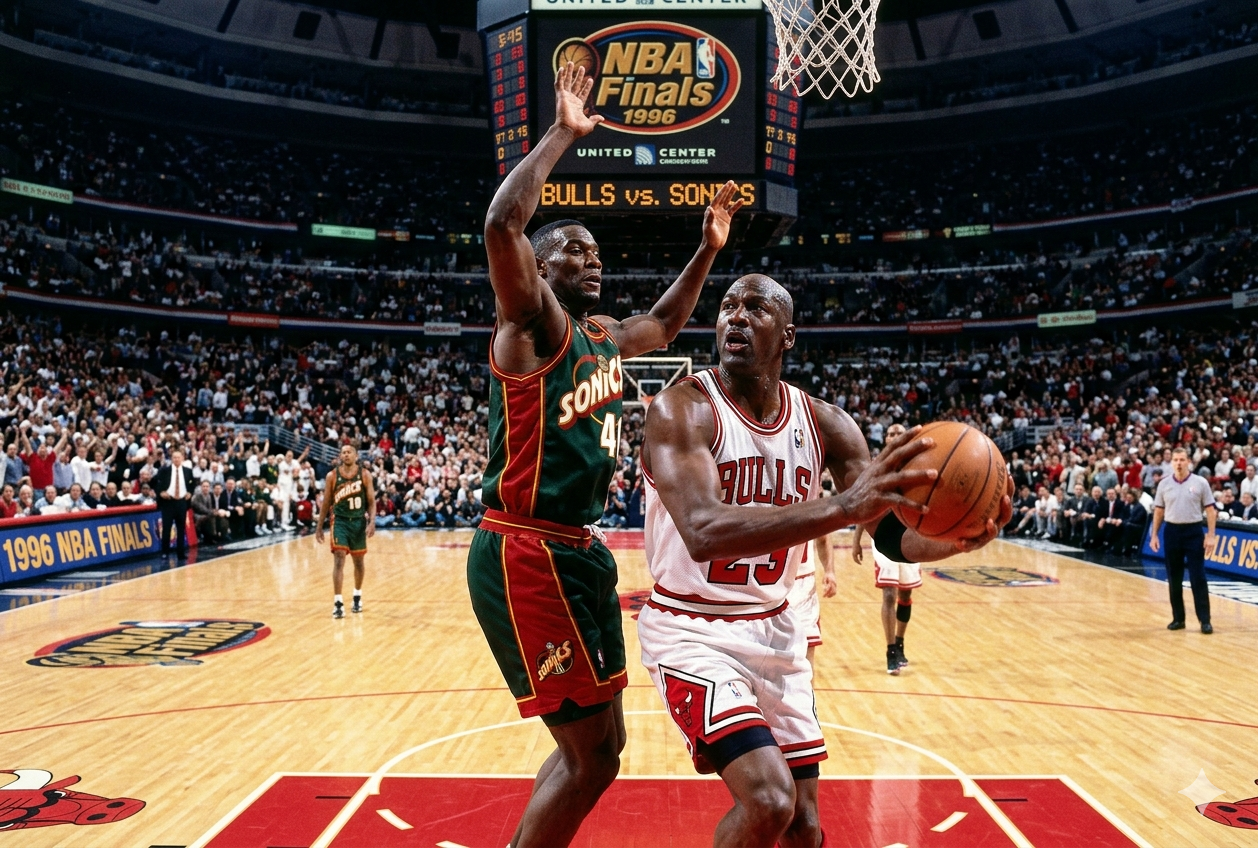
Shawn Kemp and the 1996 NBA Finals — Seattle’s Closest Shot at a Championship
In the spring of 1996, Shawn Kemp stood at the center of the basketball universe. The Seattle SuperSonics had just completed a 64-win regular season and were facing Michael Jordan’s Chicago Bulls — the 72-10 team widely considered the greatest ever assembled — in the NBA Finals. What followed was the defining chapter of Kemp’s career and the closest Seattle has ever come to an NBA championship.
The Road to the Finals
The 1995-96 SuperSonics were built around two pillars: Gary Payton’s defensive brilliance and Shawn Kemp’s physical dominance. Head coach George Karl had assembled a roster deep enough to compete with anyone in the league.
The 1995-96 Regular Season
| Stat | Result |
|---|---|
| Record | 64-18 |
| Western Conference Seed | 1st |
| Kemp PPG | 19.6 |
| Kemp RPG | 11.4 |
| Payton APG | 7.5 |
Seattle entered the playoffs as one of the most feared teams in the Western Conference.
The Western Conference Playoffs
The Sonics dispatched the Sacramento Kings in the first round, survived a tough series against the Houston Rockets in the second round, and defeated the Utah Jazz in the Western Conference Finals to reach the NBA Finals for only the second time in franchise history.
The 1996 NBA Finals: Seattle vs. Chicago
The matchup was the most anticipated Finals in years — perhaps since Magic vs. Bird. On one side: Michael Jordan, Scottie Pippen, and Dennis Rodman, fresh off a historic 72-win season. On the other: Kemp and Payton, two of the most competitive players in the game.
Game-by-Game Results
| Game | Location | Result | Kemp Stats |
|---|---|---|---|
| Game 1 | Chicago | Bulls win 107-90 | 23 PTS, 10 REB |
| Game 2 | Chicago | Bulls win 92-88 | 29 PTS, 13 REB |
| Game 3 | Seattle | Sonics win 108-86 | 21 PTS, 11 REB |
| Game 4 | Seattle | Sonics win 107-86 | 25 PTS, 11 REB |
| Game 5 | Seattle | Sonics win 89-78 | 18 PTS, 9 REB |
| Game 6 | Chicago | Bulls win 87-75 | 19 PTS, 9 REB |
The Sonics lost the series 4-2, but the three consecutive wins in Seattle remain one of the most dramatic stretches in Finals history.
Kemp’s Performance — Rising to the Moment
Shawn Kemp’s 1996 Finals performance is often overshadowed by Jordan’s brilliance, but the numbers tell the story of a player who was genuinely extraordinary throughout the series.
Kemp’s 1996 Finals Averages
| Stat | Average |
|---|---|
| Points | 22.6 |
| Rebounds | 10.2 |
| Blocks | 1.8 |
| Field Goal % | 53.4% |
Against arguably the greatest defensive team ever assembled, Kemp averaged nearly 23 points and 10 rebounds per game. He was 26 years old and at the absolute peak of his physical powers.
Games 3, 4 & 5 — When Seattle Believed
The moment the series seemed to turn was Game 3, played in front of a deafening KeyArena crowd. Kemp was unstoppable — attacking the basket, finishing through contact, and providing the kind of physical presence that had Rodman visibly frustrated.
Games 4 and 5 continued the run. For three straight games, the Sonics controlled the series. Seattle genuinely believed a championship was coming.
Gary Payton’s Defense on Jordan
One of the enduring storylines of the series was Coach Karl’s decision — beginning in Game 4 — to assign Gary Payton as the primary defender on Michael Jordan. The “Glove” held Jordan to below his series averages in Games 4 and 5, and many observers believe the adjustment, made earlier, might have changed the outcome.
Game 6 — The Heartbreak
Back in Chicago for Game 6, the Bulls were not going to lose. Jordan delivered one of his most focused performances, and the Sonics couldn’t sustain the momentum they’d built in Seattle.
The Bulls won 87-75. Jordan was named Finals MVP. Chicago celebrated its fourth championship of the decade.
For Seattle, it was the end of the closest thing to a championship the franchise would ever experience.
The Legacy of 1996 for Seattle
The 1996 Finals run remains the emotional high-water mark for SuperSonics basketball. The team, the era, and the performances of Kemp and Payton are still discussed by Seattle sports fans with a mixture of pride and wistfulness.
When the Sonics ultimately relocated to Oklahoma City in 2008, the 1996 Finals became even more significant in the memory of the city — the last great chapter of a story that ended too soon.
Frequently Asked Questions About the 1996 NBA Finals
How did Shawn Kemp perform in the 1996 NBA Finals?
Shawn Kemp averaged 22.6 points, 10.2 rebounds, and 1.8 blocks per game in the 1996 NBA Finals against the Chicago Bulls. Despite playing against one of the greatest teams ever assembled, Kemp was spectacular throughout the series, particularly during Seattle’s three consecutive wins in Games 3, 4, and 5.
Did the Seattle SuperSonics win the 1996 NBA Finals?
No. The Seattle SuperSonics lost the 1996 NBA Finals to the Chicago Bulls 4 games to 2. The Sonics won three consecutive games (Games 3, 4, and 5) before losing Game 6 in Chicago. It remains the only NBA Finals appearance in franchise history.
Why did Seattle lose the 1996 NBA Finals?
Seattle lost the 1996 Finals primarily because of Michael Jordan’s sustained brilliance and the Bulls’ overall depth and experience. Many analysts also point to the coaching decision to deploy Gary Payton on Jordan too late in the series — a move that proved effective but came in Game 4 rather than Game 1.
Who won the 1996 NBA Finals MVP?
Michael Jordan won the 1996 NBA Finals MVP award, his fourth Finals MVP honor. Despite Shawn Kemp’s strong series, Jordan’s 27.3 points per game on efficient shooting made him the clear choice.
What record did the 1995-96 Chicago Bulls set?
The 1995-96 Chicago Bulls finished the regular season with a 72-10 record — the best regular season record in NBA history at the time and still among the best ever. They defeated the Seattle SuperSonics in six games to claim the championship.
Conclusion
The 1996 NBA Finals represent the summit of Shawn Kemp’s career and the defining moment of SuperSonics history. Kemp was brilliant, Seattle was electric, and the series gave the city three nights of genuine championship belief before Jordan’s Bulls proved too much. It remains one of the great “what if” moments in NBA history. To understand the full arc of what made Kemp and that Sonics team special, explore his complete career stats and his Seattle SuperSonics legacy.