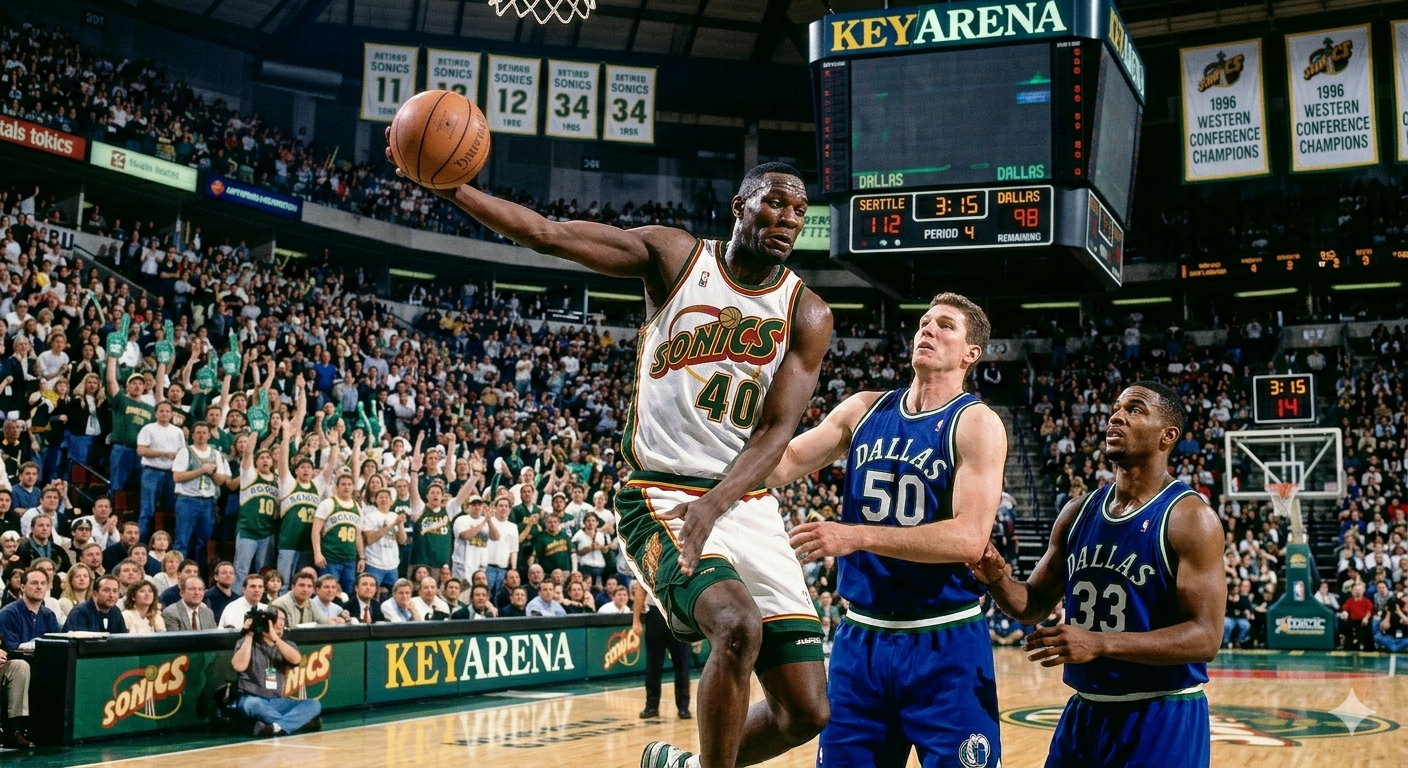
Why Did Shawn Kemp Leave Seattle? The Full Story Behind the Trade
Shawn Kemp was the Seattle SuperSonics. For eight seasons, he was the team’s emotional engine, its most electrifying player, and the man who made KeyArena shake on a nightly basis. So why did the Sonics trade him in 1997? The full story is more complicated — and more human — than most sports fans realize.
Kemp’s Rise as the Face of the Sonics
From the moment Shawn Kemp entered the league in 1989 as a 19-year-old from Elkhart, Indiana, it was clear he was something special. He hadn’t played a single game of college basketball — coming straight out of high school after a brief stint at Kentucky — but his raw athleticism was unmistakable.
Building His Legacy in Seattle
By the early 1990s, Kemp had developed into one of the most dominant big men in the NBA. Alongside point guard Gary Payton, he formed one of the league’s most feared duos. The “Glove and the Reign Man” partnership became the identity of Seattle basketball.
Kemp’s dunk contests, his ferocious style of play, and his genuine connection to the Seattle fanbase made him a local icon. Six straight All-Star selections between 1993 and 1998 confirmed what everyone in Seattle already knew — Shawn Kemp was elite.
The 1996 NBA Finals — So Close
The closest Kemp came to a championship was the 1995-96 season. The Sonics finished with a 64-18 record, one of the best in franchise history, and fought through the Western Conference playoffs to reach the NBA Finals.
Facing the Chicago Bulls
There, they met Michael Jordan’s 72-win Chicago Bulls — one of the greatest teams ever assembled. Kemp was extraordinary throughout the series, averaging over 23 points and 11 rebounds. The Sonics pushed the Bulls to six games before falling short.
It was the peak of everything Kemp and Seattle had built together. Few in the city could have imagined it would be his last full postseason run as a Sonic.
The Contract Dispute That Changed Everything
Following the 1996 Finals run, Kemp wanted a new contract that reflected his status as one of the game’s elite players. The numbers he was seeking — reported to be in the range of $100 million — were seen as too steep by Sonics ownership and general manager Wally Walker.
A Breakdown in Negotiations
The relationship between Kemp and the organization deteriorated through the 1996-97 season. Kemp was earning approximately $2.5 million per year — well below market value for a six-time All-Star and Finals performer. He felt underpaid and undervalued.
The tension was palpable. Kemp made his frustrations public. The Sonics, meanwhile, were unwilling to commit to a max-level deal given concerns about Kemp’s conditioning and lifestyle choices that had become increasingly visible to the organization.
The Trade to Cleveland
In the summer of 1997, the Seattle SuperSonics traded Shawn Kemp to the Cleveland Cavaliers in exchange for power forward Vin Baker.
Trade Details
| Sonics Received | Cavaliers Received |
|---|---|
| Vin Baker | Shawn Kemp |
| Draft considerations | — |
For Kemp, the deal came with a reward: the Cavaliers immediately signed him to a seven-year, $107 million contract — one of the largest deals in NBA history at the time.
For Seattle, it was the end of an era. The trade was met with shock and grief by the Sonics fanbase, many of whom have never fully moved on.
What Happened After the Trade
Kemp’s first season in Cleveland was genuinely productive. He averaged 18.5 points and 9.2 rebounds, suggesting the change of scenery hadn’t diminished him.
The Decline
But by his second season with the Cavaliers, the cracks were showing. Weight gain and personal struggles — including legal issues and the highly publicized acknowledgment of fathering multiple children — became dominant storylines. His production dropped steadily over three seasons in Cleveland.
By the time he joined the Portland Trail Blazers and later the Orlando Magic, Kemp was a shadow of the player who had terrorized defenses in Seattle.
Seattle’s Reaction — Then and Now
The trade left a wound on the Seattle basketball community that time has only partially healed. The SuperSonics themselves would eventually leave Seattle in 2008 — relocating to Oklahoma City as the Thunder — compounding the city’s sense of loss.
Kemp himself has remained connected to Seattle over the years, frequently returning for events and maintaining warm relationships with former teammates. For many Sonics fans, he remains the defining player of the franchise’s greatest era.
Frequently Asked Questions
Why did Shawn Kemp leave Seattle?
Shawn Kemp was traded from the Seattle SuperSonics to the Cleveland Cavaliers in 1997 primarily due to a contract dispute. Kemp wanted a significant pay increase after years of being underpaid relative to his All-Star status, and the Sonics were unwilling to meet his asking price given concerns about his lifestyle and conditioning.
What did Seattle get in the Shawn Kemp trade?
The SuperSonics received power forward Vin Baker from the Cleveland Cavaliers in exchange for Shawn Kemp. The trade was widely considered a loss for Seattle in hindsight, as Baker never matched Kemp’s impact.
How much did Shawn Kemp make in Cleveland?
Upon being traded to Cleveland, Shawn Kemp signed a seven-year, $107 million contract with the Cavaliers — one of the richest deals in the NBA at that time.
Did Shawn Kemp ever return to Seattle?
Shawn Kemp never returned to play for the SuperSonics after the 1997 trade. He has, however, remained a beloved figure in Seattle, frequently visiting the city and participating in community events.
Was the Shawn Kemp trade a mistake?
Most basketball analysts and Sonics fans consider the trade a significant mistake in hindsight. Vin Baker struggled with personal issues of his own in Seattle, and the Sonics never again reached the NBA Finals after Kemp’s departure.
Conclusion
The trade that sent Shawn Kemp from Seattle to Cleveland stands as one of the most consequential — and heartbreaking — deals in SuperSonics history. A contract dispute, organizational concerns, and poor timing conspired to end one of the great player-city relationships in NBA history. To understand his full impact on the franchise, read our complete breakdown of Shawn Kemp’s Seattle SuperSonics career.